Diabetes: The World’s Most Ignored Pandemic (and Why Treating It Costs So Much)
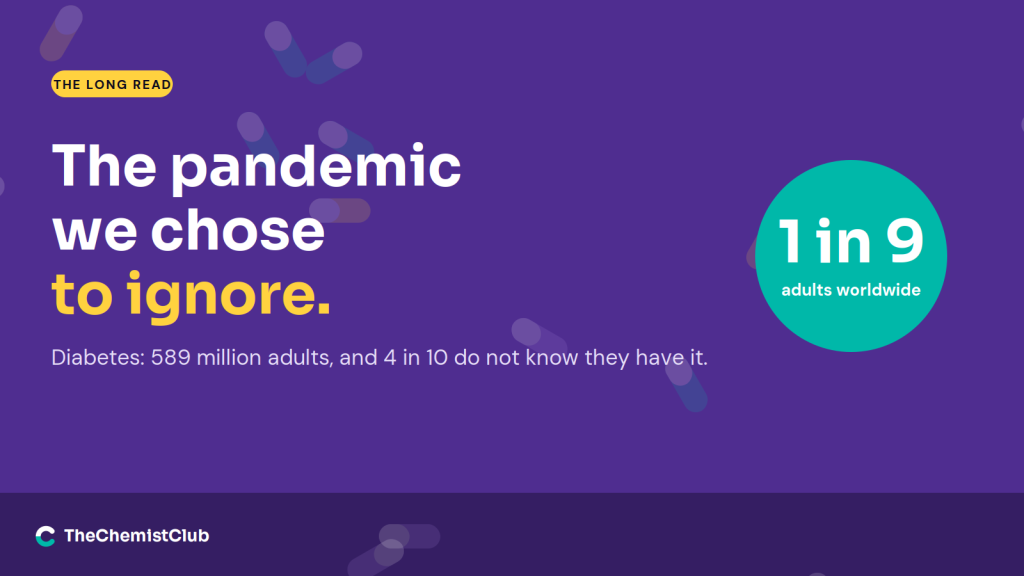
Imagine a disease that affects one adult in nine on Earth, kills an estimated 3.4 million people a year, and goes undiagnosed in four out of every ten of the people who have it. You would expect daily headlines and emergency summits. Instead, you get silence, and then a pharmacy bill.
That disease is diabetes. It is common, treatable and, for many people, preventable. It is also one of the most neglected health crises of our time. This guide puts the data on the table, says the uncomfortable parts out loud, and walks through every kind of treatment, from tablets and injections to insulin, inhaled insulin and glucose monitors.
Key takeaways: 589 million adults live with diabetes, and about 252 million of them have never been diagnosed (IDF, 2025). Type 2 diabetes, the most common form, can often be prevented or delayed. Treatment runs from pennies-a-day tablets to injectables that cost around US$1,000 a month at US list price, and in the United States the price of insulin has pushed roughly 1 in 4 insulin users to ration it. Never stop or stretch a diabetes medicine without talking to your doctor first. There are safer ways to cut the cost.
Is diabetes really a “pandemic”?
Sceptics will object to the word, and they have a point. Strictly speaking, a pandemic is an infectious outbreak that crosses borders, and diabetes does not pass from person to person. But look at what it does do. It has spread to every region of the world. In 1990 an estimated 198 million adults had it; by 2022 that number had grown to 828 million (NCD-RisC, The Lancet, 2024). It travels with shared exposures: cheap calories, desk jobs, ageing populations, stress and short sleep.
The word is deliberate. A fast virus gets a headline. A slow one gets a prescription. Diabetes has no single dramatic week, so it never forces the world to look up. That is exactly what makes it one of the most commonly ignored global health crises.
Did you know? About 4 in 5 adults with diabetes live in low- and middle-income countries, which is where screening, medicines and monitors are hardest to reach.
The numbers nobody puts on the front page
The headline figures deserve to be read slowly, with the source beside every number:
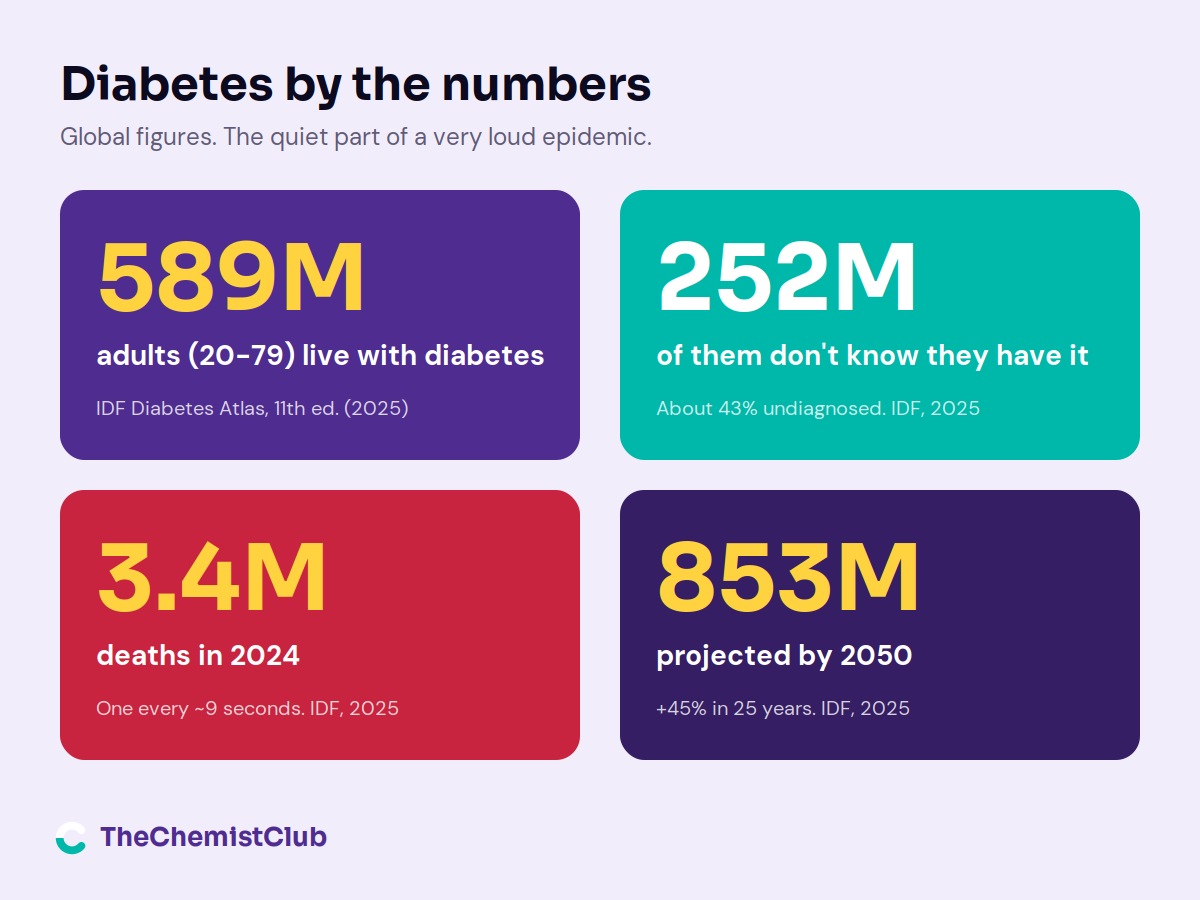
- 589 million adults (20 to 79) lived with diabetes in 2024, about 1 in 9 (IDF Diabetes Atlas, 11th edition, 2025).
- 252 million of them, about 43%, did not know it (IDF, 2025).
- 853 million adults are projected to have diabetes by 2050 (IDF, 2025).
- 3.4 million deaths were linked to diabetes in 2024, roughly one every nine seconds (IDF, 2025).
- More than US$1 trillion a year is spent on diabetes-related health care worldwide (IDF, 2025).
- 59% of adults aged 30 and over with diabetes were not taking any medicine in 2022 (NCD-RisC, The Lancet, 2024).
- In the United States, 38.4 million people have diabetes, about 8.7 million of them undiagnosed, and 97.6 million adults have prediabetes (CDC National Diabetes Statistics Report).
- US diabetes costs reached US$412.9 billion in 2022 (American Diabetes Association).
The story is not only that diabetes is common. It is that most of the damage falls on people who were never told, or were told and never treated.
“But I feel fine.” Why diabetes stays hidden
If diabetes were serious, wouldn’t you feel it? Not for years, and that is the trap. Type 2 diabetes builds quietly, and when symptoms do appear they are easy to explain away:
- Constant thirst and frequent urination, especially at night
- Tiredness that sleep does not fix
- Blurred vision
- Cuts and sores that heal slowly
- Tingling or numbness in the hands or feet
- Frequent infections, or unexplained weight loss
Many people have none of these. Their first sign is a complication: an eye exam that finds damage, failing kidneys, a heart attack, a stroke or a foot ulcer. The WHO lists diabetes as a leading cause of blindness, kidney failure, heart attack, stroke and lower-limb amputation.
The test that finds it is simple and cheap. An HbA1c blood test between 5.7% and 6.4% points to prediabetes, and 6.5% or above points to diabetes. A fasting blood glucose of 126 mg/dL (7.0 mmol/L) or higher does the same. A doctor confirms the result and decides what happens next.
Warning: Extreme thirst, fast weight loss, vomiting, stomach pain, fruity-smelling breath or drowsiness can signal diabetic ketoacidosis, a life-threatening emergency. Go to emergency care immediately. Do not wait for an appointment.
Real stories behind the statistics
Numbers are numbers. People make them real.
Start with Alec Smith. Alec was 26 and living with type 1 diabetes in Minnesota. When he aged off his mother’s health plan in 2017, the supplies he needed for one month were quoted at around US$1,300. He rationed what he had, and according to widely reported accounts he died within weeks. His mother, Nicole Smith-Holt, turned her grief into a campaign, and Minnesota passed the Alec Smith Insulin Affordability Act in 2020.
Now go back a century. When Frederick Banting, Charles Best and James Collip produced insulin in the early 1920s, they sold the patent to the University of Toronto for one dollar each, so that the drug would reach everyone who needed it. Today, about nine-tenths of the world’s insulin market is held by three companies.
Then there is the bus. In 2019, groups of Americans with diabetes began travelling from Minnesota to Ontario, Canada, to buy insulin at a fraction of the US price. It sounds like a joke. It was a real protest and a real shopping trip.
Finally, the research. In 2019, researchers at a Yale diabetes clinic surveyed patients and reported in JAMA Internal Medicine that about 1 in 4 (25.5%) had used less insulin than prescribed because of cost, and those patients tended to have poorer blood sugar control.
Remember: Rationing insulin is not a lifestyle choice. It is a symptom of a pricing system.
Why is diabetes treatment so expensive in the West?
Insulin is a hundred years old. Its price should have fallen long ago. So why hasn’t it?
First, a correction: “the West” is not one market. In the UK and much of Europe, public systems absorb most of the cost of insulin and diabetes medicines, and patients pay in other ways: waiting lists, and rationed access to sensors and newer drugs. The sharpest price problem for insulin is in the United States, where a RAND Corporation study found that 2018 list prices were about 8.4 times the average of 32 other countries.
Researchers, and the US Senate Finance Committee’s 2021 insulin investigation, point to a handful of factors:
- A tiny club of makers. Three companies dominate the global supply, so there is little price competition.
- High list prices and hidden rebates. Manufacturers set a high “list” price, then pay rebates to middlemen (pharmacy benefit managers) for good placement on insurance lists. Patients with deductibles, or no insurance, can pay close to the list price.
- Product churn. Moving patients from older vials to newer analogues and pens can extend patent protection, which delays cheaper copies.
- Insurance design. High-deductible plans, coverage cliffs and age limits (like the one Alec Smith hit) leave people exposed at the exact moment they need insulin every day.
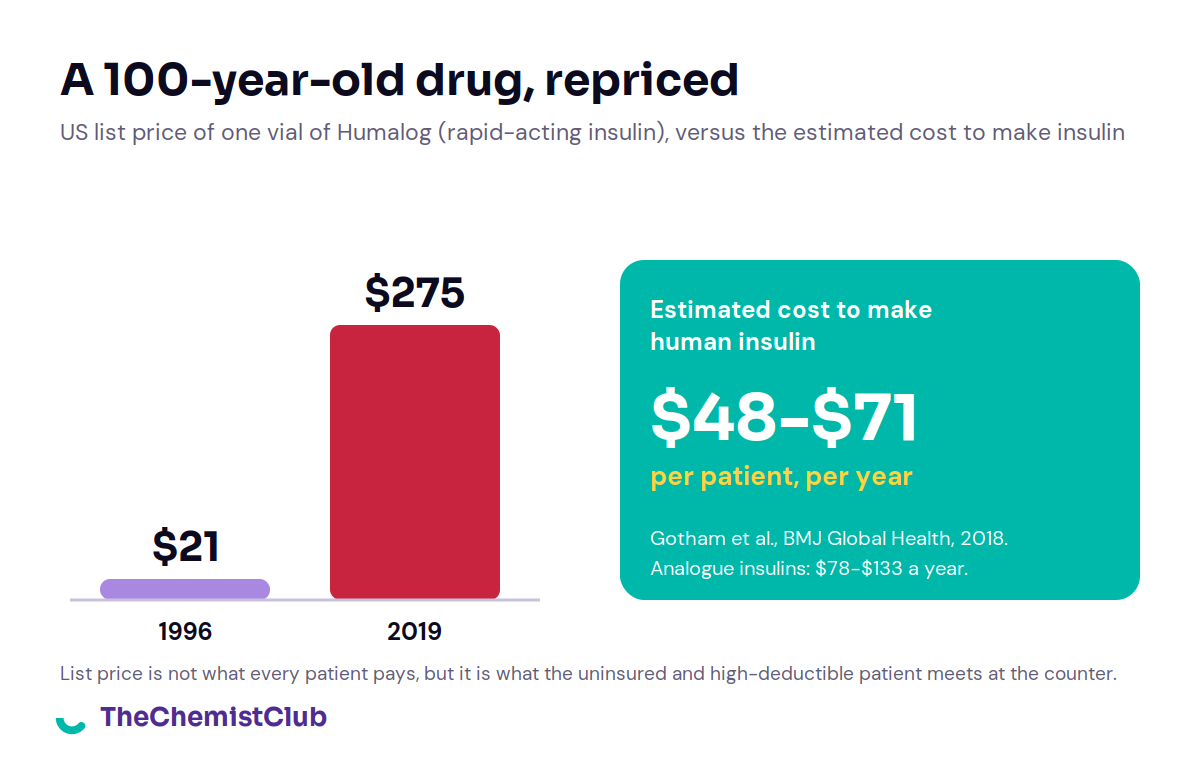
One data point shows the gap. The list price of a vial of Humalog rose from about US$21 in 1996 to about US$275 in 2019. Meanwhile, a 2018 analysis in BMJ Global Health (Gotham and colleagues) estimated that human insulin could be produced and sold at a profit for roughly US$48 to US$71 per patient per year.
Is the problem fixed? Partly. Since 2023 Medicare Part D caps insulin at US$35 a month, and in 2023 and 2024 the three major makers announced large list-price cuts and $35 programs. That is real progress. But the relief depends on your insurance and your country, and it does not cover the newer drugs and sensors that now make up much of a modern diabetes bill.
Note: Manufacturers argue that analogue insulins, pens and newer drug classes cost real money to develop and make life measurably easier, and that net prices after rebates are lower than list prices. Critics reply that patients buy at list price, not net. Both statements can be true at once, which is why the fight goes on.
The controversial question: is this a disease of “bad choices”?
Isn’t type 2 diabetes mostly people’s own fault? This is the question that keeps people from being tested, so it deserves a careful answer. Food, activity, sleep and weight clearly matter, and the evidence that lifestyle change works is strong (more on that below). But “own fault” ignores a lot:
- Genes matter. People of South Asian, East Asian, Black and Hispanic backgrounds often develop type 2 diabetes at lower body weights.
- Environment matters. Ultra-processed food is cheap and everywhere, while fresh food, safe places to walk and time to cook are not equally available.
- Stress, shift work and poor sleep raise risk independently.
- Type 1 diabetes, about 1 in 10 cases, has nothing to do with lifestyle at all.
Blame has a measurable cost: shame delays diagnosis. Policy argues over the rest. Supporters of sugar taxes, such as those introduced in Mexico in 2014 and the UK in 2018, say they push manufacturers to cut sugar and fund health programs. Opponents say they hit low-income households hardest and that the evidence on diabetes outcomes is still thin. Reasonable people land in different places.
The position here is simple: personal responsibility and shared responsibility are not rivals. You can own your next meal and still demand a food system and a pharmacy system that do not work against you.
How to avoid diabetes (or delay it for decades)
Prevention is not wishful thinking. For many people with prediabetes, the evidence is surprisingly good. In the US Diabetes Prevention Program trial, published in 2002, people at high risk who lost around 7% of their body weight and did about 150 minutes of activity a week cut their chance of developing type 2 diabetes by 58%. Metformin cut it by 31%. In the DiRECT trial in the UK, 46% of people with recently diagnosed type 2 diabetes who followed a structured weight-loss program were in remission after one year.
What helps, in plain language:
- Get tested. Ask for an HbA1c or fasting glucose test, especially if you are over 35, carry extra weight around your waist, have a close relative with diabetes, had gestational diabetes, or have South Asian, Black, Hispanic or Indigenous ancestry. Doctors may suggest starting earlier.
- Move most days. Aim for about 150 minutes a week of brisk activity, plus a short walk after meals if you can.
- Shift your plate, don’t starve it. More vegetables, beans, whole grains, nuts and protein. Fewer sugary drinks and ultra-processed snacks.
- Aim for modest weight loss if you are overweight. Even 5% to 7% matters.
- Protect your sleep. Short or broken sleep raises insulin resistance.
- Stop smoking. It raises the risk and worsens complications.
- Review your medicines. Some drugs, such as steroids, can raise blood sugar. Ask your doctor, but do not stop anything on your own.
- Repeat the test. If you have prediabetes, check yearly.
Tip: If you are told you have “borderline” blood sugar, ask for the exact words: “Do I have prediabetes, and when should I be retested?” A vague answer is a missed chance.
Note: Remission is not a cure. Weight regain and age can bring diabetes back, so keep your checkups.
Diabetes medicines explained, one type at a time
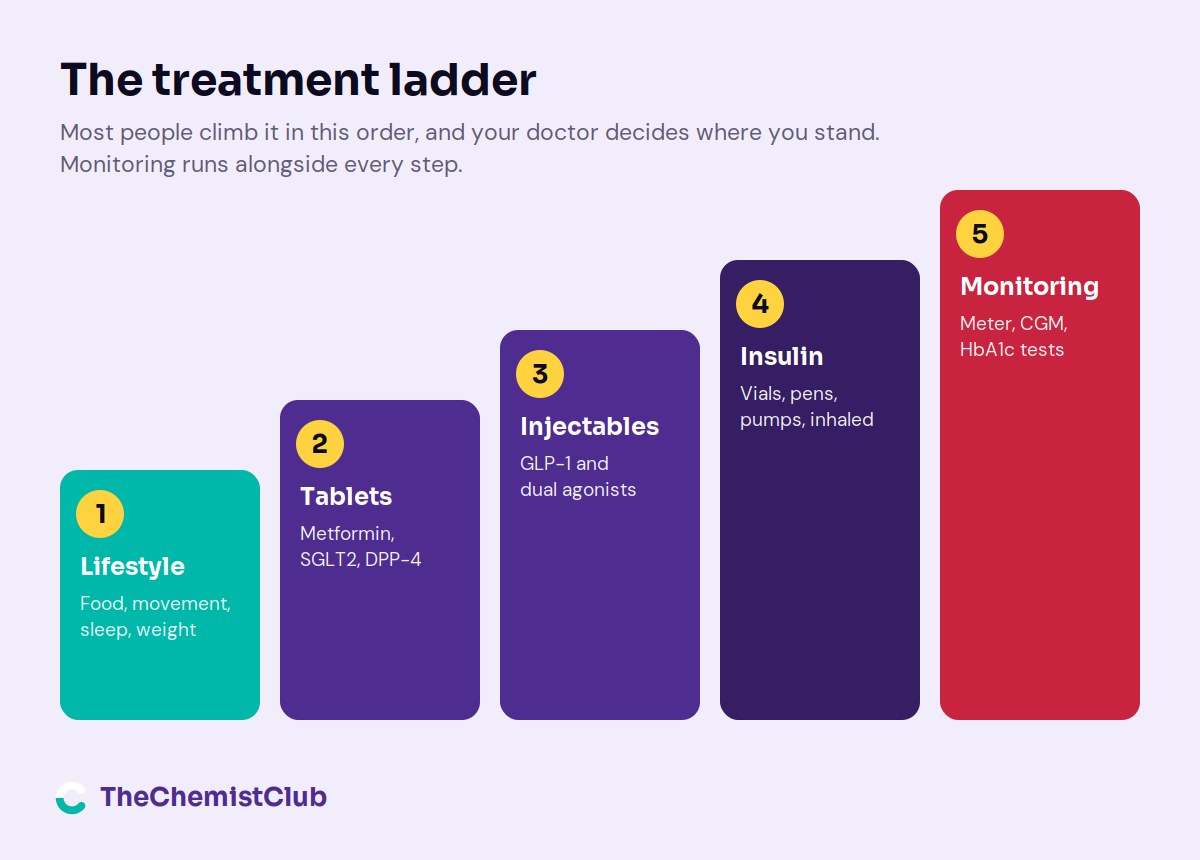
There are many treatments, and the choice can feel overwhelming. Think of a ladder. Most people start with lifestyle change, add tablets, may move to non-insulin injections, and use insulin when their body needs more help. Monitoring runs alongside every step. Your doctor decides where you stand, and many people use more than one step at once. This is a guide, not a prescription.
Diabetes tablets
Tablets are where most people with type 2 diabetes begin, and many are cheap generics.
- Metformin: usually the first choice. It lowers the liver’s sugar output and improves insulin sensitivity. Often costs a few dollars a month. Common side effect: an upset stomach, which extended-release versions ease.
- Sulfonylureas (gliclazide, glimepiride, glipizide): push the pancreas to release more insulin. Low cost, but can cause low blood sugar and weight gain.
- SGLT2 inhibitors (empagliflozin, dapagliflozin, canagliflozin): help the kidneys remove sugar in urine, and have proven heart and kidney benefits. Watch for genital infections and, rarely, ketoacidosis.
- DPP-4 inhibitors (sitagliptin, linagliptin, vildagliptin): gentle, low risk of lows, often combined with metformin.
- Pioglitazone: improves insulin sensitivity. Can cause fluid retention and weight gain.
Browse diabetes tablets on The Chemist Club
Non-insulin injections: GLP-1 and dual agonists
This is the newest, most talked-about group: semaglutide, dulaglutide, liraglutide and tirzepatide. They mimic gut hormones that raise insulin when you eat, slow digestion and reduce appetite. Many are injected once a week, and an oral semaglutide exists too. They lower blood sugar, help with weight loss and show heart benefits in trials. Nausea is the common side effect. Cost is the common complaint, with US list prices around US$1,000 a month for several brands, which is why shortages, imitation products and “compounded” versions have become a safety concern. Insist on genuine, prescribed product.
Browse injectables for diabetes
Insulin
Insulin is essential for type 1 diabetes and for many people with advanced type 2. There are several kinds:
- Rapid-acting (lispro, aspart, glulisine): taken at mealtimes.
- Short-acting (regular human insulin): cheaper, older, slower to start.
- Intermediate (NPH): lasts about half a day, often twice daily.
- Long-acting (glargine, detemir, degludec): a steady background dose.
- Premixed: a fixed blend of two types, for simpler routines.
It comes as vials with syringes, or as pens and cartridges, which are easier to dose and carry. Unopened insulin is usually stored in a refrigerator (2 to 8 degrees Celsius) and never frozen. Once in use, most pens and vials are kept at room temperature for a limited time, so read the leaflet of your exact product.
Warning: Insulin and some tablets can cause hypoglycemia (low blood sugar): shakiness, sweating, confusion, hunger, a racing heart. Carry fast-acting sugar, and ask your doctor about an emergency glucagon kit.
Browse insulin on The Chemist Club
Inhaled insulin
Yes, it exists. Inhaled insulin is a fast-acting powder breathed in at the start of a meal, as an alternative to a rapid-acting injection. The first product, Exubera, was withdrawn in 2007 after poor sales. Afrezza, approved by the US FDA in 2014, has since carved out a small but loyal following, and it works quickly. It still needs a long-acting insulin for background cover in type 1 diabetes. It is not suitable for people who smoke or have asthma or COPD, and lung function should be tested first. Availability depends heavily on country.
Ask a pharmacist about inhaled insulin
Monitors, meters and sensors
You cannot treat what you cannot see. There are three levels of monitoring:
- Blood glucose meters: a finger-prick and a test strip. Cheap meters, but the strips are the running cost.
- Continuous glucose monitors (CGM): a small sensor worn on the skin, usually for 10 to 15 days at a time, sending readings every few minutes to a phone or reader. A common goal is more than 70% of the day in the range 3.9 to 10.0 mmol/L (70 to 180 mg/dL).
- HbA1c: a lab blood test that shows your average over about three months.
Browse glucose monitors and strips
Can’t afford it? What to do instead of rationing
If your medicine is too expensive, taking less is not the answer. Cutting insulin or other diabetes medicine without medical advice can push your blood sugar to dangerous levels within days. Do these things instead:
- Say the price out loud to your doctor. Ask if a cheaper equivalent works: generic metformin, human insulin instead of an analogue, or a biosimilar.
- Ask for a 90-day supply and for the generic name on the prescription so that the pharmacist can substitute.
- Look up manufacturer and government programs. In the US, all three major insulin makers have offered $35-a-month programs, with eligibility rules. Check the current terms.
- Compare prices across licensed pharmacies. With a valid prescription, prices can differ enormously between countries and sellers. Import rules vary, so ask before you order, and check storage and shipping for anything that needs cooling.
- Use community clinics and charities. Many run free or sliding-scale diabetes care.
- Avoid unverified sellers. The WHO estimates around 1 in 10 medical products in low- and middle-income countries is substandard or falsified. A cheap fake is the most expensive medicine there is.
Our pharmacists can check your prescription and help you compare options. You can upload your prescription, explore the Patient Assistance Program, or talk to a pharmacist.
Quick answers to common questions
What is the difference between type 1 and type 2 diabetes?
Type 1 is an autoimmune condition in which the body stops making insulin, and it always needs insulin. Type 2, about 90% of cases, develops when the body resists insulin and the pancreas cannot keep up. It is often managed first with lifestyle changes and tablets.
Can type 2 diabetes be reversed?
It can go into remission, especially after significant weight loss soon after diagnosis (46% at one year in the DiRECT trial). It is not a cure. Blood sugar can return, so regular checks continue.
What is the cheapest effective diabetes medicine?
For most adults with type 2 diabetes, generic metformin is the lowest-cost, best-evidenced starting point. The right medicine depends on your kidneys, heart, weight and other conditions, so your doctor chooses.
Is inhaled insulin better than injected insulin?
It is faster and needle-free for mealtime doses, but it is not “better” for everyone. It is not suitable for smokers or people with chronic lung disease, and it is not available everywhere. Most people still need a long-acting injection.
Do I need a continuous glucose monitor if I have type 2 diabetes?
Guidelines strongly support CGM for people who use insulin. For people on tablets only, the benefit is less settled, so discuss it with your care team.
Why is insulin so expensive in the United States?
Three manufacturers dominate supply, list prices are high and offset by hidden rebates, and uninsured or high-deductible patients pay close to list price. Patent strategies have also delayed cheaper alternatives.
Is it safe to buy diabetes medicines online?
It can be, when the seller is a licensed pharmacy, a valid prescription is required, products are genuine and cold-chain items are shipped correctly. Be wary of any site that sells prescription medicine without asking for a prescription.
The bottom line
Diabetes is not ignored because it is rare, or unsolved, or mysterious. It is ignored because it is slow and silent, and because, critics argue, there is more money in managing it for life than in ending it early. The science to prevent, delay and treat it exists. What is missing is early testing, honest conversation, and prices a person can pay.
Key takeaways: Get tested. Learn your HbA1c number. Treat prediabetes as a deadline, not a diagnosis. Never ration medicine; ask for cheaper equivalents instead. Buy only genuine products from licensed pharmacies. And talk about it, because shame is the most expensive symptom of all.
Have you been quoted a price you could not pay, or caught diabetes early because of a routine test? Tell us your story and, with your permission, we may feature it in a future piece.
Sources and further reading
- International Diabetes Federation, IDF Diabetes Atlas, 11th edition (2025), diabetesatlas.org
- NCD Risk Factor Collaboration, “Worldwide trends in diabetes prevalence and treatment from 1990 to 2022,” The Lancet (2024)
- World Health Organization, Diabetes fact sheet, who.int
- US Centers for Disease Control and Prevention, National Diabetes Statistics Report, cdc.gov
- American Diabetes Association, “Economic Costs of Diabetes in the U.S. in 2022,” Diabetes Care (2024)
- RAND Corporation, international comparison of insulin prices (2020), rand.org
- US Senate Finance Committee, staff report on insulin pricing (2021)
- Gotham D. et al., “Production costs and potential prices for insulins,” BMJ Global Health (2018)
- Herkert D. et al., “Prevalence and Consequences of Cost-Related Insulin Underuse,” JAMA Internal Medicine (2019)
- Diabetes Prevention Program Research Group, New England Journal of Medicine (2002)
- Lean M. et al., DiRECT trial, The Lancet (2018, 2019)
This article is for general information and is not a substitute for advice from your treating doctor.