 15% Off
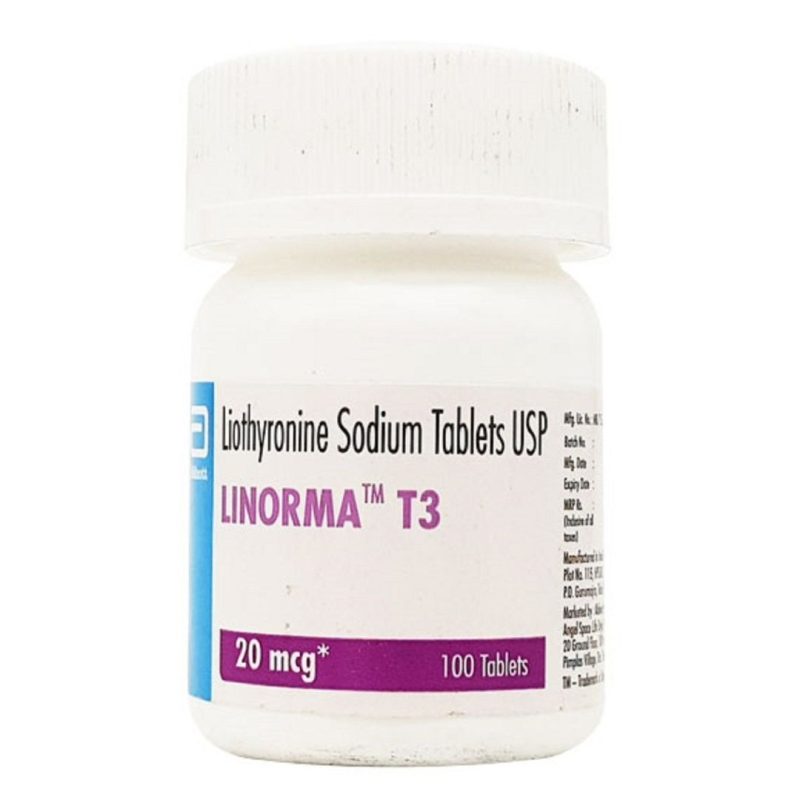
Liothyronine T3 20mcg Tablet
Tablet · 100 Tablets per Box
- Composition
- —
- Manufacturer
- Abbott
- Pack
- 100 Tablets per Box
- Genuine stock
- Discreet packaging
- Export documents on request
About Liothyronine T3 20mcg Tablet
Drug: Liothyronine Sodium (T3) | Class: T3 Thyroid Hormone | Brand: Cytomel (Pfizer); Linorma T3 (Abbott Pharma India) | Indication: Hypothyroidism (T4 non-responders), myxoedema coma, thyroid cancer suppression, augmentation of T4 | Dose: Hypothyroidism: 25mcg once daily, titrate
Quick Answer — What is Liothyronine used for?
Liothyronine is used for hypothyroidism (t4 non-responders), myxoedema coma, thyroid cancer suppression, augmentation of t4. Evidence-based for DIO2 gene polymorphism patients; BTA guideline: T3 add-on when T4 monotherapy insufficient. Liothyronine (T3) works faster than T4 — symptoms may improve within days, but TSH monitoring every 2–3 months is essential.
Liothyronine – T3 Thyroid Hormone
Liothyronine contains Liothyronine Sodium (T3), a t3 thyroid hormone for hypothyroidism (t4 non-responders), myxoedema coma, thyroid cancer suppression, augmentation of t4. Evidence-based for DIO2 gene polymorphism patients; BTA guideline: T3 add-on when T4 monotherapy insufficient.
Product Information
| Attribute | Details |
|---|---|
| Generic Name | Liothyronine Sodium (T3) |
| Drug Class | T3 Thyroid Hormone |
| Brand Reference | Cytomel (Pfizer); Thyrofit (Sun Pharma India) |
| Indication | Hypothyroidism (T4 non-responders), myxoedema coma, thyroid cancer suppression, augmentation of T4 |
| Standard Dose | Hypothyroidism: 25mcg once daily, titrate. Myxoedema coma: 20–40mcg IV/tube. T4 augmentation: 12.5–25mcg added to levothyroxine |
| Form | Tablet |
| Route | Oral |
| Prescription | Yes |
| Evidence | Evidence-based for DIO2 gene polymorphism patients; BTA guideline: T3 add-on when T4 monotherapy insufficient |
How It Works
Active T3 thyroid hormone binding nuclear receptors normalising metabolism.
People Also Ask
What is the difference between Liothyronine and levothyroxine?
Levothyroxine is T4 — a prohormone converted to active T3 in tissues, with a 7-day half-life providing stable levels. Liothyronine is the active T3 hormone with a 1-day half-life — faster onset but requiring more frequent dosing and causing greater T3 fluctuations. Most patients are managed on T4 alone; T3 is added in specific cases.
How is Liothyronine monitored?
TSH blood tests every 6–8 weeks until stable, then annually. For carbimazole: CBC monitoring for agranulocytosis. For T3: more frequent TSH monitoring due to faster T3 fluctuations.
Can Liothyronine be taken in pregnancy?
Hypothyroidism in pregnancy requires careful management — TSH targets are tighter (0.1–2.5 mU/L). Levothyroxine dose usually increases 25–30% in pregnancy. Carbimazole: use PTU in first trimester (methimazole/carbimazole avoided due to foetal abnormality risk). Liothyronine: minimal data, generally avoided in pregnancy.
What foods interact with Liothyronine?
Calcium supplements, iron, antacids, and high-fibre foods reduce levothyroxine absorption — separate by 4 hours. Soy products modestly reduce T4 absorption. Carbimazole and liothyronine have fewer food interactions but maintain consistent dosing times.
Does Liothyronine cause weight changes?
Treating hypothyroidism (levothyroxine, liothyronine): 2–5kg modest weight loss as metabolic rate normalises. Treating hyperthyroidism (carbimazole): weight gain of 2–4kg as normalised thyroid function reduces hypermetabolism.
Storage
Store at 15–30°C away from sunlight and moisture. Keep out of reach of children.
Reviews
Be the first to share how it worked for you.
Only logged in customers who have purchased this product may leave a review.
Reviews
There are no reviews yet.